Business concept
A customer learning platform that listens
A consent-first research workspace that connects themes to interviews and keeps disagreements visible.
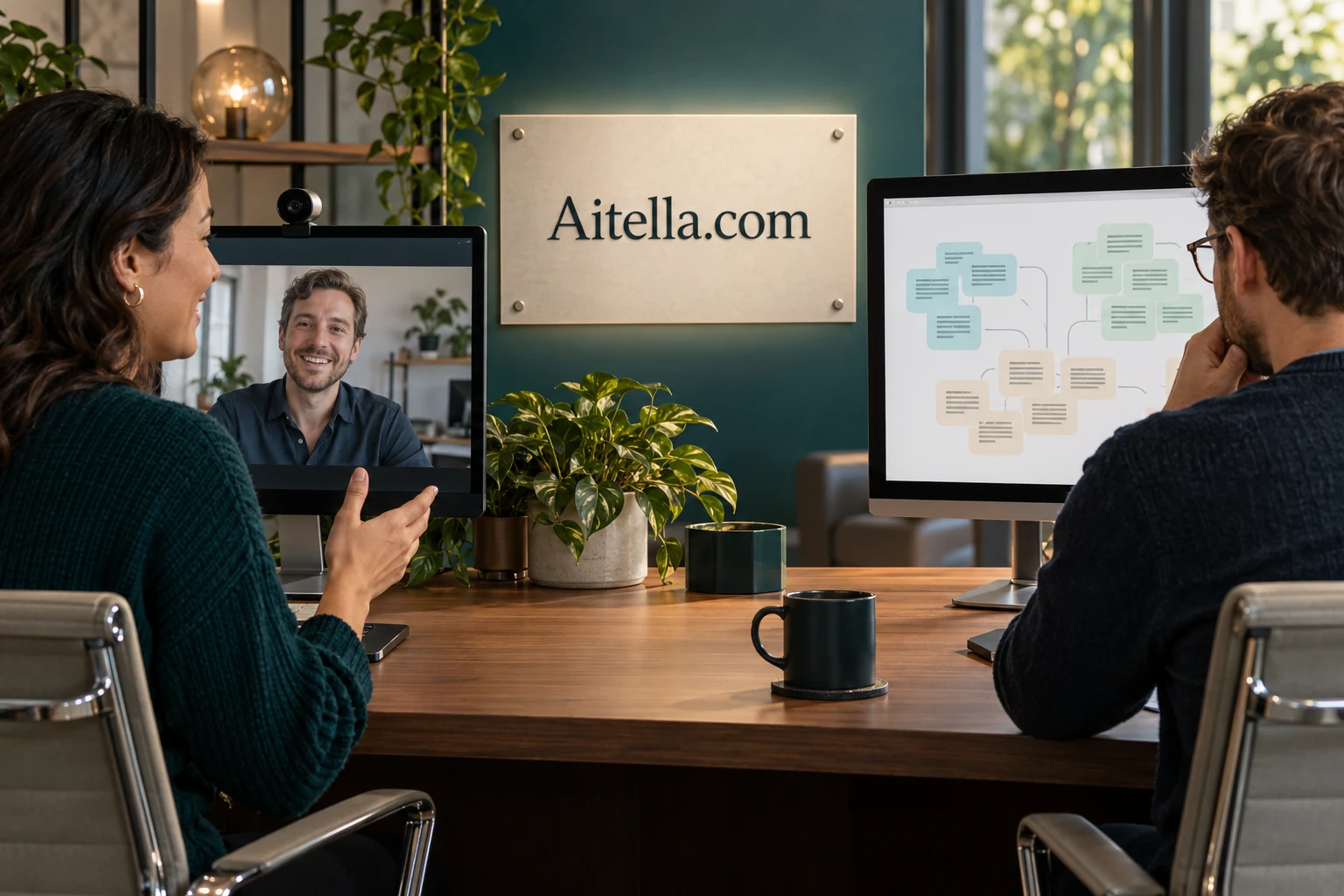
Aitella could be a customer learning platform that helps research teams turn consented interviews into evidence they can inspect and share. This illustrative concept starts with a specific problem: useful observations become difficult to revisit when recordings, transcripts and findings live in separate places. The product would organize that material without treating a generated summary as a replacement for research judgment.
Serve the team that owns the interviews
The first buyer could be a research lead at a software company with a recurring interview program. Researchers, product managers and designers might all use the findings, but the research team should control the collection and interpretation process. Interviews would explore how people work, what they are trying to achieve and where the current product fails them. The platform would need to preserve that context.
A first offer could focus on a complete synthesis packet for one study: transcripts, evidence-linked themes, differences between participants and unanswered questions. It would not need to predict customer behavior or automatically choose a roadmap. The buyer should understand exactly which part of the research work the product supports. That makes it easier to compare with the team's current tools and habits.
Before ingestion, the team would confirm that participant consent and its own data policies permit the intended processing. Product settings should support access controls, retention choices and removal of material when needed. Those controls should reflect the actual workflow rather than relying on a general consent checkbox. The team remains responsible for deciding what it may collect and how it may use it.
Preserve the path from theme to evidence
Imagine a study about onboarding difficulties. Three participants describe uncertainty about who can approve a workspace, while another reports that the approval process worked well. A summary that says users cannot obtain approval would erase the disagreement. A useful platform would present the theme, link the supporting passages and show the counterexample. The researcher could decide whether the difference relates to role, account configuration or another factor.
Every quoted passage should resolve to its place in the transcript or recording, with enough surrounding context to understand it. Paraphrases should be identified as paraphrases. A theme should show which interviews support it rather than letting repeated statements from one participant appear to represent several people. Evidence counts can assist navigation, but they should not be presented as population statistics from a small qualitative study.
The interface could distinguish observations, interpretations and proposed actions. A participant's difficulty finding a setting is an observation; a researcher inferring that navigation labels are unclear is an interpretation; redesigning the settings menu is a proposed action. Keeping those layers separate helps colleagues challenge a conclusion without losing the original evidence. It also makes revisions less disruptive when a new interview changes the picture.
Design for correction and disagreement
Researchers should be able to revise speaker labels, exclude irrelevant passages and merge or split themes. The platform should show that a finding changed and retain the relevant revision context. It should not silently replace a reviewed synthesis when a model or prompt is updated. A team's published research record needs a stable reference point even if the underlying tools evolve.
A useful evaluation set could include interviews with similar wording but different meanings, incomplete transcripts and explicit contradictions. Reviewers would check whether themes are supported, whether quotations are accurate and whether important disagreements remain visible. Microsoft's human-AI interaction guidelines provide a research-based reference for interface behavior around AI assistance. The specific research workflow proposed here would still need evaluation with its intended users.
The team should also test absence. If the available interviews do not answer a question, the system should say so. A polished answer built from adjacent topics is less useful than a clear gap that suggests a follow-up interview. Research software earns trust when it helps people distinguish what the material supports from what they still need to learn.
Find distribution through research practice
Early demonstrations could use a small synthetic study with a realistic disagreement. Show the source material, a proposed theme and a corrected finding. Researchers can then evaluate the product's evidence handling, rather than being asked to accept a dramatic insight without seeing where it came from. A concrete demonstration also makes the offer easier to discuss with a research lead who must explain it internally.
A pilot could cover one completed study and one upcoming study, with agreed data permissions and review roles. The completed material tests synthesis against known findings; the upcoming work tests whether the product fits the team's day-to-day process. The commercial question is whether that combination creates enough value to justify an ongoing subscription or a study-based fee. No assumed savings percentage is needed to begin learning.
Partnerships with research educators or specialist consultancies could provide introductions if the product supports their methods and respects their clients' data. Distribution should follow a clear use case. A platform that claims to answer every product question would be harder to evaluate and easier to misunderstand than one that helps teams review interview evidence.
Build the first study workspace
Aitella could give this platform an approachable technology identity, while the supporting language explains its research role. The brand would need to carry a careful promise: help people listen, organize and review, with researchers retaining responsibility for interpretation. That promise is different from an operations assistant that prepares decisions from structured records.
The next step is a small consented corpus and a defined synthesis task. Ask a research team to review the resulting themes, follow their source links and correct disagreements. Record where the platform helps and where it adds work. A first study workspace should make evidence easier to inspect before expanding into repositories, planning tools or automated recommendations.
The domain opportunity
Make Aitella.com part of your next chapter.
The owner reviews acquisition and partnership inquiries individually.
Inquire to purchase